Below The Haze Line: An Extinct Gaze
installation
Below The Haze Line: An Extinct Gaze, AI International Biennale, Palac Potockich, Krakow, PL
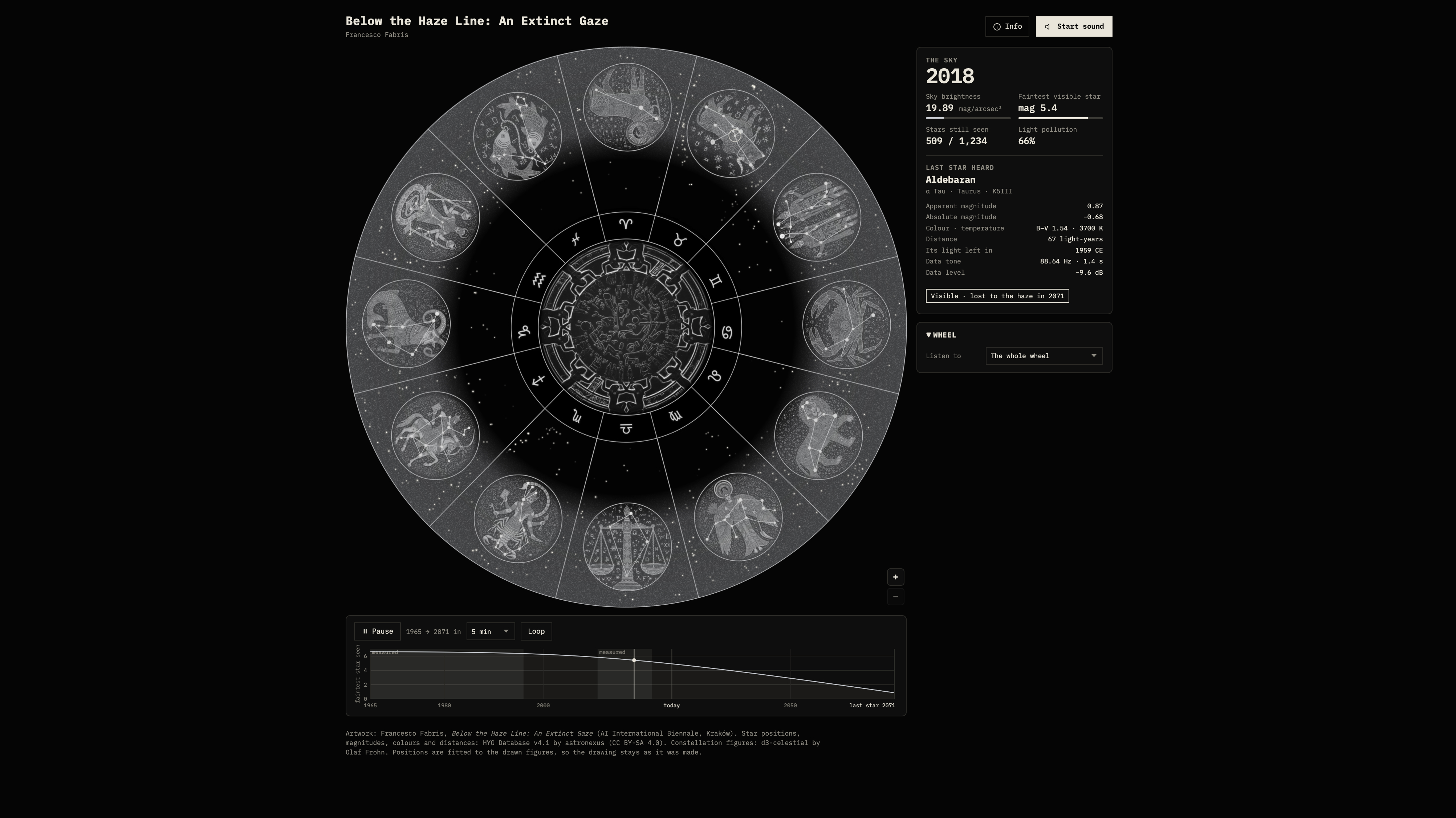
‘Below the Haze Line: An Extinct Gaze’ is an installation that reimagines our relationship with the cosmos by exploring the tension between human imagination and machine cognition. The project speculates on a future where humanity has lost the ability to directly observe the night sky, a starkly imminent reality exacerbated by environmental issues like light pollution and atmospheric haze. This erosion leaves us to rely upon raw archival data, ancient myths, and artificial intelligence to serve as our only telescope.
The sinusoidal textures originate from sonifications of scientific data from the stars within the zodiac. Here, an AI is tasked with interpreting these frequencies to retrieve a lost past, calling back to an era when our visual communion with the cosmos dictated and empowered the very rhythms of existence.
As the installation glows, the swells of brightness demonstrate light pollution’s 10% annual increase, taken in accordance with 20 years of data. This growing radiance controls an AI model trained on the constellation microtones and fed by the invisible humming of electromagnetic field recordings of global human-made light sources.
What emerges is a widening chasm of disconnection mediated by the machine. Technology fails to restore the purity of nature, hindered by the restless and omnipresent anthropocene transmissions that have saturated the world.
A fragile hope remains in the potential for human healing, currently suspended in the limbo of myth and pseudoscience. We are left to wonder: are we still in control and capable of restoring what we destroyed, or is that capability merely an illusion, realized too late to discern?
Curator: Patrycja Maksylewicz
Thanks: Intermedia Art Krakow, ASP Krakow, Icelandic Art Center.
Below the Haze Line: An Extinct Gaze WEB APP
A reworked web version of the installation can be experienced HERE
The zodiac and the oldest written tuning system both come from Mesopotamia. Here a machine listens to the stars of the zodiac and remembers them in one of those tunings, nīd qablim, the tuning of the Hurrian Hymn. The extinct gaze becomes cultural as well as optical: what disappears is not only the dark sky but a whole way of relating to it. As the haze grows, the hum of the light that hides the stars is drawn into the same ancient scale.
It is not a reconstruction of how the sky once sounded but a fiction the machine tells: an imagined memory, not a recovered one.
The real sky and the machine do not move together. The stars disappear year by year, while the machine stays fixed in the one way it learned to hear. It never sees the data, only hears the stars’ sound, and answers in the tuning it was taught. As light pollution rises, its answer comes less from the stars and more from the hum, until it hears stars that are no longer there. That widening gap, between the sky that is lost and the sky the machine remembers, is the subject of the piece.